 |
Historical Information |
|
The Flatiron Building
|
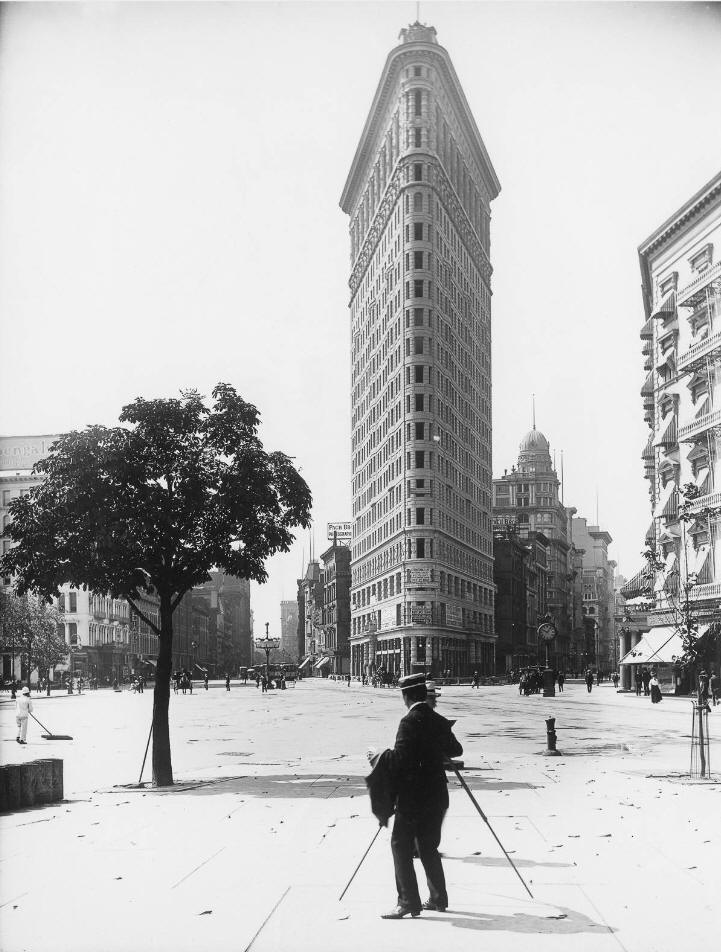
Designed by Daniel Burnham and Frederick P. Dinkelberg, the Flatiron Building was completed in 1902 and originally contained 20 floors. |
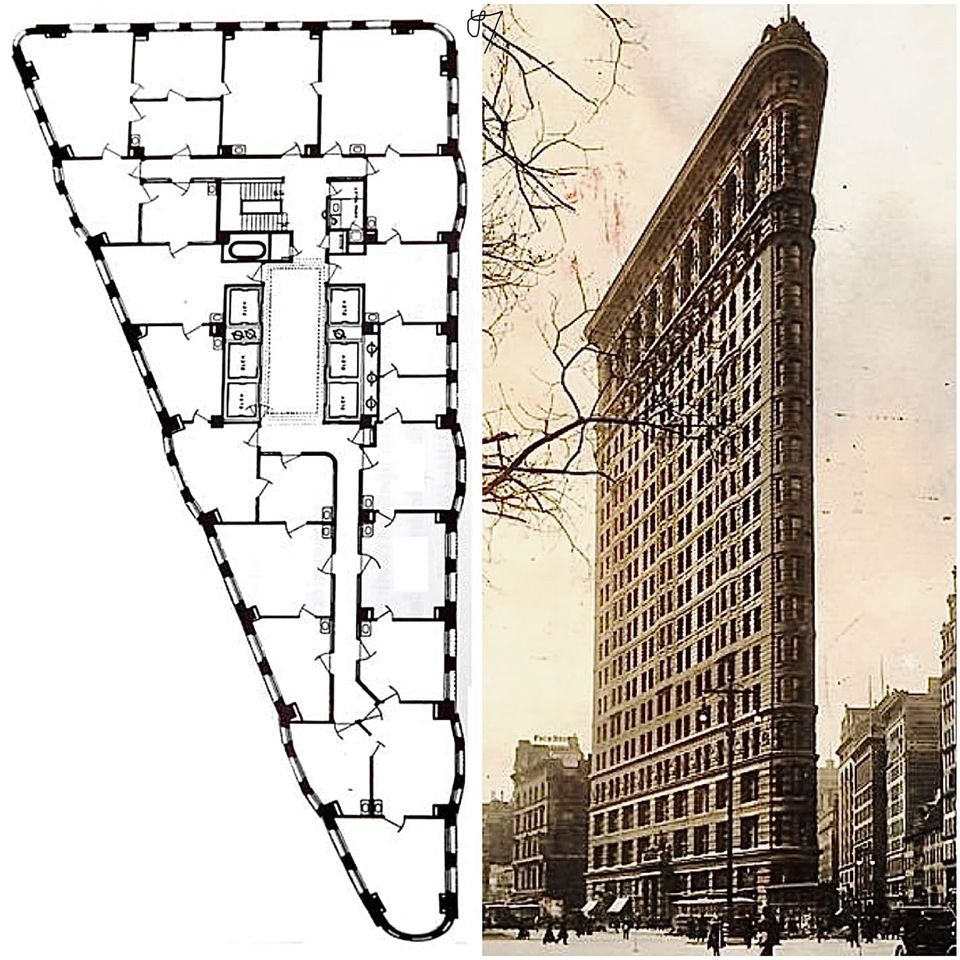
The building sits on a triangular block formed by Fifth Avenue, Broadway, and East 22nd Street—where the building’s 87-foot (27 m) back end is located—with East 23rd Street grazing the triangle’s northern (uptown) peak. The name “Flatiron” derives from its triangular shape, which recalls that of a cast-iron clothes iron. |
The Flatiron Building was developed as the headquarters of construction firm Fuller Company, which acquired the site from the Newhouse family in May 1901. |
Construction proceeded at a very rapid pace, and the building opened on October 1, 1902. A “cowcatcher” retail space and a one-story penthouse were added shortly after the building’s opening. |
 |
The Fuller Company sold the building in 1925 to an investment syndicate. The Equitable Life Assurance Society took over the building after a foreclosure auction in 1933 and sold it to another syndicate in 1945. |
Helmsley-Spear managed the building for much of the late 20th century, renovating it several times. The Newmark Group started managing the building in 1997. The building’s ownership was divided among several companies, which started renovating the building again in 2019. |
Similar to the parts of a classical Greek column, the Flatiron Building’s facade is divided into a base, shaft, and capital. |
The Fifth Avenue and Broadway elevations of the facade are both eighteen bays wide, while the 22nd Street elevation is eight bays wide; the bays are arranged in pairs. |
The southwest and southeast corners are curved, with one rounded window on each story above the base. In addition, each story of the curved prow on 23rd Street contains three sash windows; the central window is wider than the other two. Many of the Flatiron Building’s tenants referred to the prow as “the Point”. |
 |